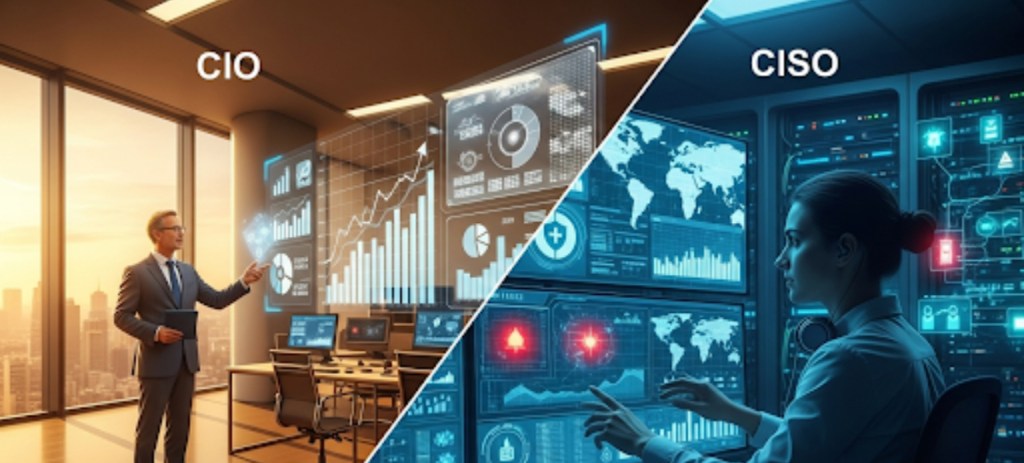
As Manchester businesses grow and adapt to the digital era, the roles of IT leaders are becoming more critical than ever. Two positions that are often confused — but serve very different purposes — are the Chief Information Officer (CIO) and the Chief Information Security Officer (CISO). While their titles sound similar, their responsibilities focus on distinct but equally vital aspects of your IT strategy.
For many SMEs, particularly those in Greater Manchester’s thriving professional services, e-commerce, and manufacturing sectors, understanding the difference between a CIO and a CISO can be the key to unlocking growth while protecting against ever-increasing cyber threats.
What Does a CIO Do?
A Chief Information Officer (CIO) provides strategic leadership around how technology supports the overall business. Their remit is wide-ranging:
- Aligning IT with business goals.
- Driving digital transformation and cloud adoption.
- Overseeing IT budgets and vendor relationships.
- Ensuring technology supports productivity and growth.
- Guiding mergers, acquisitions, and due diligence from an IT perspective.
In short, the CIO is responsible for making sure IT isn’t just keeping the lights on — but actively helping the business scale.
What Does a CISO Do?
A Chief Information Security Officer (CISO) is laser-focused on protecting the organisation’s data, systems, and reputation. Their role covers:
- Designing and enforcing cybersecurity strategies.
- Ensuring compliance with frameworks like ISO 27001, GDPR, and PCI DSS.
- Leading on risk assessments and incident response.
- Managing security awareness training across the business.
- Monitoring and reducing exposure to cyber threats.
In today’s environment of ransomware, phishing, and supply chain attacks, the CISO’s role is no longer a “nice to have.” For many organisations, it’s essential for survival.
Why SMEs in Manchester Need Both Roles
Traditionally, only large enterprises had separate CIO and CISO roles. But with SMEs increasingly targeted by cybercriminals — and with investors demanding strong IT governance — many smaller businesses are recognising the value of having both perspectives at board level.
However, most SMEs cannot justify the cost of full-time CIO and CISO positions. That’s where Fractional CIO and Fractional CISO services in Manchester come in. By working with experienced professionals on a part-time or project basis, businesses gain:
- Strategic vision from a CIO – ensuring IT drives growth, supports operations, and prepares for future acquisitions.
- Robust protection from a CISO – reducing cyber risks and ensuring compliance with regulatory demands.
Together, these perspectives create a future-ready IT function that builds trust with customers, partners, and investors alike.
How North Signal Helps
At North Signal, we provide Fractional CIO and Fractional CISO services to Manchester SMEs who need board-level IT expertise without the overhead of full-time appointments. Our services include:
- Fractional CIO Manchester – guiding digital transformation, system audits, and IT strategy.
- Fractional CISO Manchester – strengthening cybersecurity posture, achieving compliance, and managing risk.
- ISO 27001 consultancy – helping organisations achieve and maintain certification.
- GDPR and PCI DSS compliance – ensuring your business handles data securely and lawfully.
Whether you’re preparing for an acquisition, seeking to modernise legacy systems, or aiming to reduce security risks, North Signal helps you bridge the gap between IT strategy and IT security.
 North Signal